
The Guide
Everything we know about our corner of the mountain — tap in. ❄️
Wifi & trash.
The essentials, made painless — the two things everyone asks about, plus what to do if something goes wrong. 🏠
📱Staying connected
Mobile coverage in the village is solid on the main networks. For data on the go, an eSIM is the easy answer — Ubigi rides the two strongest rural networks here (about US$17 for 10 GB); Airalo also works well. Set it up before you fly.
🚑If someone gets hurt
Emergency: 119 (ambulance/fire) · 110 (police). Operators can bring an interpreter on the line.
Ski knocks and sore knees: Myoko Physio in Akakura — Australian-trained, English-speaking. For anything bigger, Keinan General in Arai — message us first and we’ll call ahead. Pharmacy: Sundrug in Arai.
🗑️ Rubbish, the Myōkō way ごみの分別
Japan sorts its waste seriously. Your job is simple: sort into the labelled bins in the house and we handle the rest. Please don’t take bags to the neighbourhood collection point — it’s residents-only, and the crows have a union. 🐦⬛
Food scraps, tissues, dirty paper, most kitchen waste.
Wrappers, trays, bags with the プラ mark. Rinse first.
Cap off, label off, rinse, crush. Caps & labels → プラ.
Rinsed cans and bottles, separated.
Broken ceramics, small metal bits. When in doubt, ask.
Leave it by the bins with a note. Genuinely — correct move.
❄️ Snow-country sense 雪国の心得
- 🏠Roofs 落雪
- Never stand or park under the eaves. Roof snow lets go without warning, by the hundred-kilo sheet. The one rule we’re strict about.
- 🥾Walking 凍結
- Small steps, hands out of pockets, assume every smooth surface is ice — because it is.
- 🔥Heating 暖房
- If you use a kerosene heater: crack a window for a minute every hour or two, and off before bed.
- 🚜Mornings 除雪
- Snowplows pass early and they are magnificent. Keep the parking edge clear and never shovel snow onto the road.
Travel.
Tokyo to our front door is about three and a half hours, and the last ten minutes are the best part. Two trains, one taxi, no stress.
🚅Shinkansen to Nagano
From Tokyo Station, ride the Hokuriku Shinkansen to Nagano — the Kagayaki does it in about 80 minutes (all reserved seats), the Hakutaka in about 100. Trains leave two or three times an hour. Around ¥8,000–8,600.
From Narita: the Narita Express runs straight to Tokyo Station (~60 min). From Haneda: Monorail to Hamamatsuchō, then the JR loop two stops.
🚃Local train to Myōkō-kōgen
At Nagano, follow signs to the Shinano Railway · Kita-Shinano Line (its own platforms — the JR Pass isn’t valid here). Board a train bound for Myōkō-kōgen: about 45 minutes, ¥850, roughly hourly. Bring a little cash as backup.
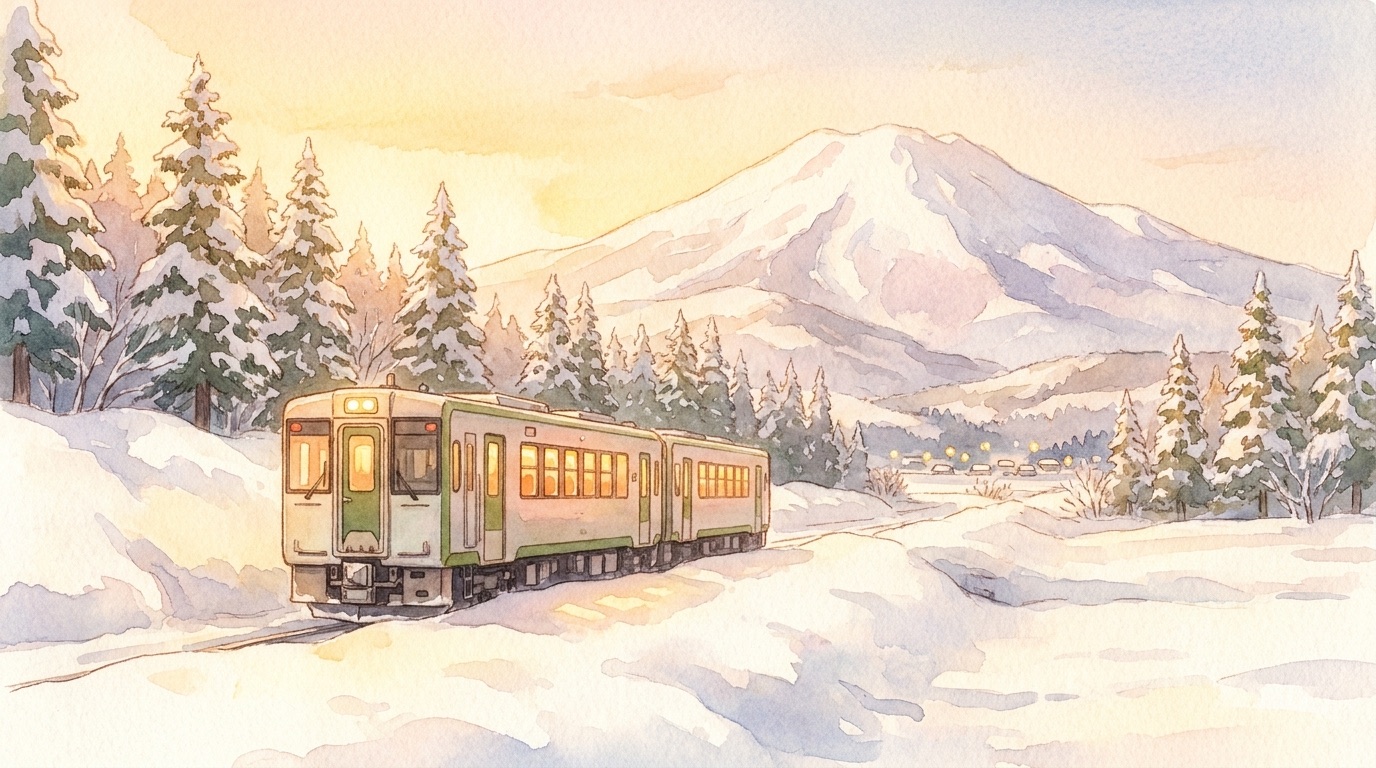
It’s a slow two-carriage train past Lake Nojiri into the snow country. Sit on the right; you’ll see Myōkō appear. 🏔️
🚕Taxi to Suginosawa
From the station it’s a 10–15 minute taxi to the chalet (roughly ¥2,000–3,500 per car). The local firm is Kōgen Taxi · 0255-86-3141 — Japanese only, 4WD fleet, cash preferred. Tell us your train and we’ll book it for you; pre-book anything after 8pm.
🧳Send the heavy bags ahead
Don’t wrestle a ski bag through Tokyo Station. Yamato TA-Q-BIN forwards suitcases and ski bags from any airport counter or hotel desk to the chalet for roughly ¥2,000–3,000 per item — hand them over two days ahead and travel light. Label to the chalet with your name and check-in date, and tell us it’s coming.
📍 Finding us 住所
- 🏡Address 住所
- 2485 Suginosawa, Myōkō-shi, Niigata 949-2112
〒949-2112 新潟県妙高市杉野沢2485 - 🗣️Show a driver タクシーで
- 「妙高市杉野沢2485までお願いします」
Myōkō-shi Suginosawa ni-yon-hachi-go made onegai shimasu.
🚗 Getting around 車
🚗Renting a car
Pick up at Nagano or Jōetsu-Myōkō station. Winter cars come on studless snow tyres as standard (tick the box anyway) — and ask for 4WD; the climb to Suginosawa deserves it. Roughly ¥8,000–12,000/day. Bring passport, home licence, and a 1949-convention International Driving Permit issued before you travel.
🛣️Driving here
From Tokyo: Kan-Etsu then Jōshin-Etsu Expressway to Myōkō-Kōgen IC — about 3.5–4 hours, ~¥6–7,000 in tolls. The chalet is ten minutes from the interchange. Roads are snow-covered December to March and constantly plowed. Leave double the Google time in a storm.
🚌Taxis & shuttles
Kōgen Taxi · 0255-86-3141 — 06:00–23:30, Japanese only. We’ll book your dinner runs; always pre-book the ride home before you go out. In season the Mt. Myoko Shuttle links Suginohara with Akakura and Ikenotaira a few times daily.
🛒The big shop
For a proper self-catering run: Harashin supermarket in Arai (Sundrug beside it), 20–25 minutes down the hill — do it on arrival day, on the way up. Quick top-ups: the 7-Eleven near the IC (its ATM takes foreign cards). The Michi-no-Eki Arai complex has a fish market and food halls.
Food.
Suginosawa itself is sleepy — a few good doors and a lot of snow. Akakura, ten minutes away, has fifty. Two rules for January and February: book dinner ahead (we’ll happily call — many places are phone-only, Japanese-only), and carry cash; ¥10–15,000 a head covers a very good night. 🏮
🏘️ In the village 杉野沢
Walkable from the chalet, give or take a snowbank.
🍕Two Pines Pizza & Wine
Stonebaked pizza and a properly curated wine list, in the heart of the hamlet. Open nightly through the season. Our default “we skied too hard to cook” plan.
🍺The Den at Red Fox Lodge
Aussie-style pub comfort — burgers, parmas, cold beer, warm room. One of the village’s few evening lights; say hi to everyone, because everyone’s there.
🍜Misa — on the mountain
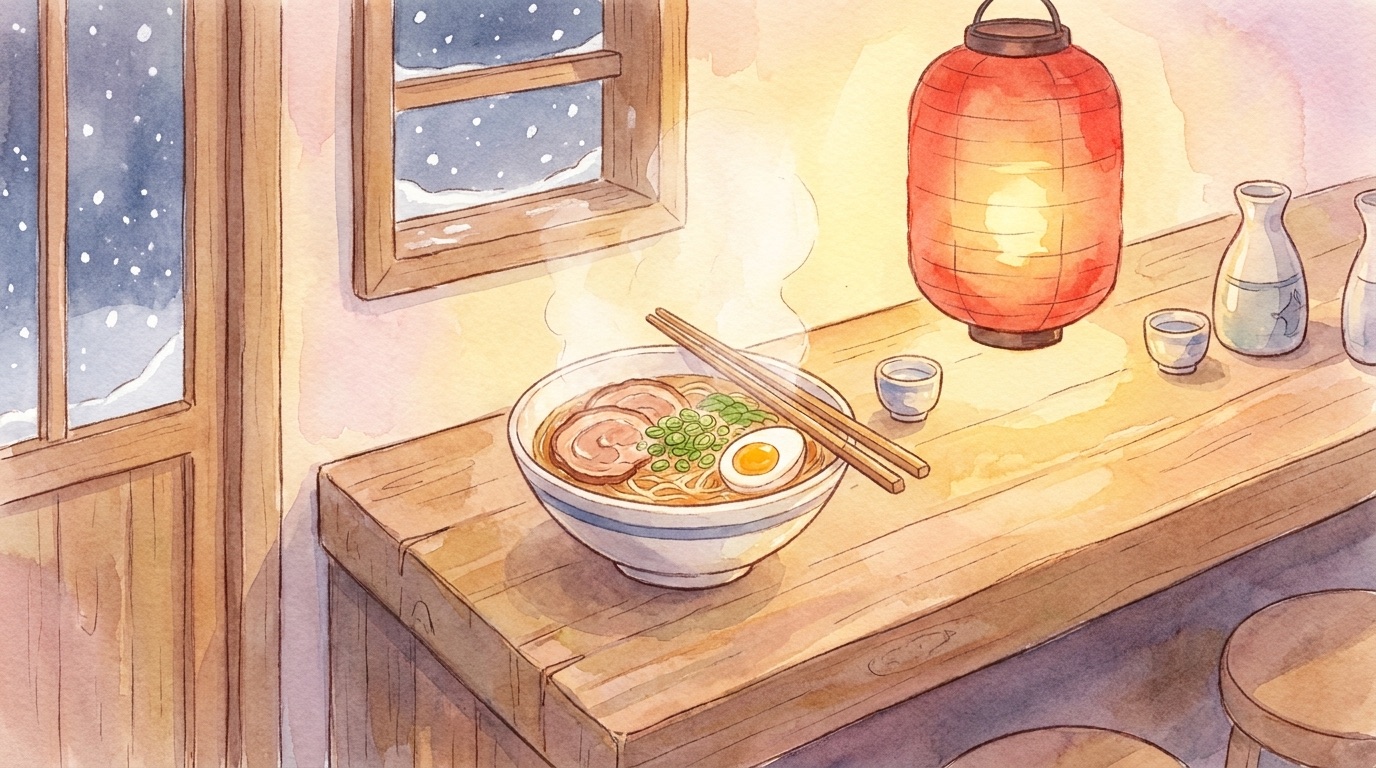
The miso ramen institution by the Mitahara lifts — sixty years of warming people up. The correct answer to “where shall we have lunch?” on any cold day.
🏮 Akakura, ten minutes away 赤倉
The dining town. Book the small places or watch other people eat in them.
☕Akakura Cafe
Scandi-look cafe by day — flat whites, smashed avo, eggs benedict — wine and whiskey bar by night. The international living room of Akakura.
🫘Myoko Coffee
Local roaster doing the best espresso on the mountain, with toasties on local bakery bread. Small, warm, worth the detour.
🍢Yakitori Asagao
Charcoal yakitori from same-day chicken. Near impossible without a reservation — which is exactly the endorsement it sounds like. Ask us to call.
🍽️Restaurant Shibata
Big friendly menu, vegetarian and vegan options, lunch and dinner — one of the most dependable tables in Myōkō for a mixed group.
🦑Udon no Fu
Family-run home of the squid-ink udon. They hand you a bib. Accept the bib.
🍶Harumi & Kei & Sennin
The izakaya circuit: Harumi for classic small plates and sake, Kei for the eclectic corner spot (order the salmon tower), Sennin for the tiny husband-and-wife room with an English menu. All small, all beloved, all booked out in February.
🚙 Worth the drive 足をのばして
🐷Tonjiru Tachibana
The region’s pilgrimage dish: an outrageous pork-and-onion miso soup that’s been on national TV more often than most politicians. Expect a queue. Join it.
🥢Kirishita Yabu Soba
Sixty years of handmade soba across from the post office near Myōkō-kōgen station. Tempura soba, done properly, no fuss.
🍥Arakin Ramen
The local ramen favourite across from the Landmark building — ideal on the way home from Alpen Blick laps.
The mountains.
Five ski areas share this volcano, each with its own personality — none of them crowded by the standards of anywhere else. When it snows all night, you already live at the right one. ⛷️
Myōkō Suginohara ★
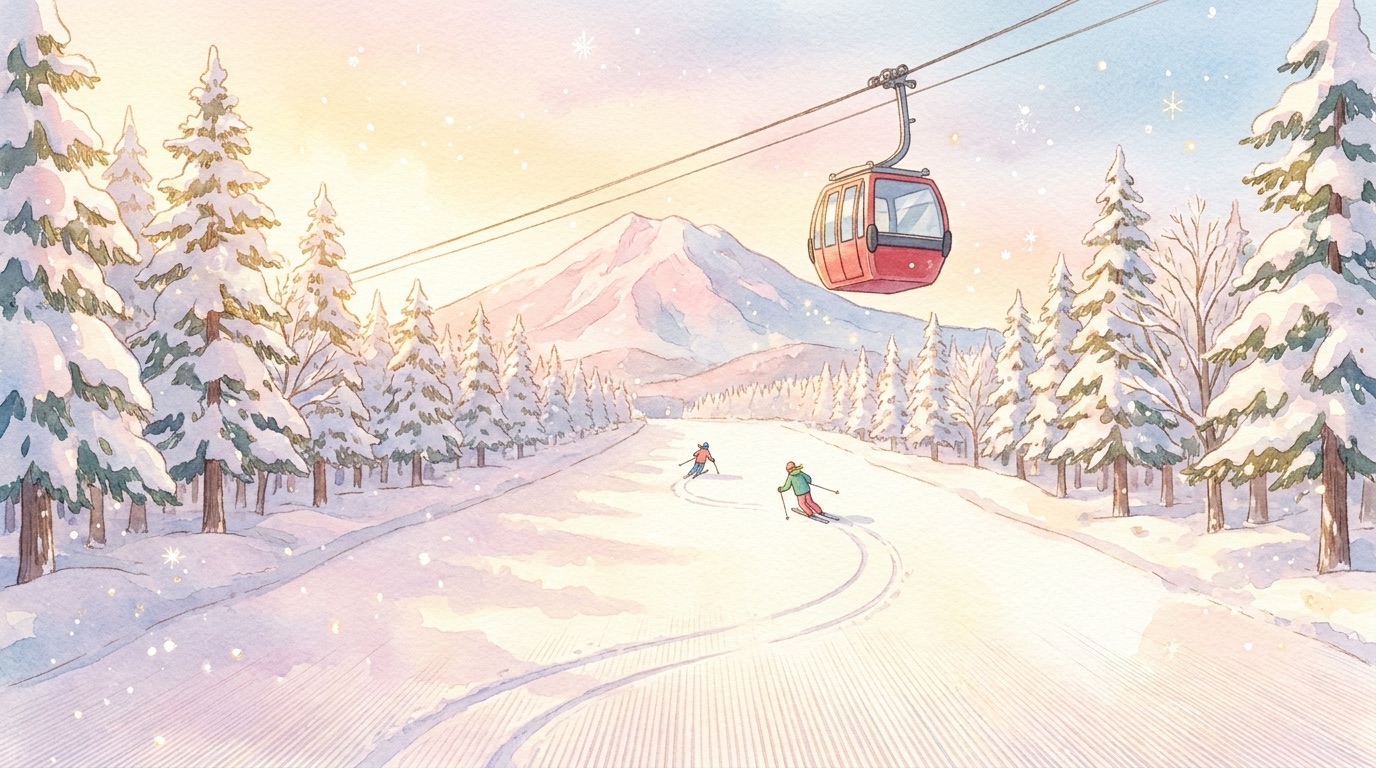
An 8.5 km top-to-bottom run — one of Japan’s longest — off 1,124 m of vertical, with a gondola that takes 15 unhurried minutes. Wide cruisers, quiet trees off the top, and Sugi Park in the Mitahara zone. Lifts 8:30–16:00, mid-Dec to late March. No night skiing — that’s what dinner is for.
On the Ikon Pass — 7 days (Base Pass 5), no blackouts. If you already carry Ikon, your home mountain is free.
🐣Ikenotaira · Alpen Blick
Next door. Wide, gentle, relaxed — the place to find your snow legs, with easy-angle official tree runs where powder sits untouched embarrassingly late.
🌙Akakura Onsen
Myōkō’s main resort town: wide beginner-friendly slopes, onsen steam in the streets, and the area’s only night skiing (17:00–21:00, ~¥3,500). Pair floodlit laps with dinner in the village.
🎩Akakura Kanko
Japan’s grand old ski resort, est. 1937 — the best fall-line groomers around and the famous slope-side hotel terrace, coffee above a sea of clouds. Links with Akakura Onsen at the top; one joint ticket covers both.
🕰️Seki Onsen
Two old lifts, the deepest snow in Myōkō, famously relaxed tree runs. Steep, tiny, retro, glorious. The advanced rider’s storm-day pick — go early, bring cash.
🏔️Arai (Lotte Arai Resort)
Luxury hotel resort with the region’s most serious lift-accessed terrain — huge gate-accessed, avalanche-controlled freeride zones. Steeps, bowls, and a spa afterwards. Worth one big day of any trip.
🎒Backcountry
Suginohara’s top lift is the gateway: a ~90-minute skin gains Mitahara-yama (2,347 m) on the crater rim. It’s real avalanche terrain: read the Japan Avalanche Network’s daily Myōkō bulletin (below), go guided, carry beacon/shovel/probe, always.
Guides we’d point you to: Dancing Snow, Myoko Guiding Co., Powder Recon, Canyons. Tell us what you’re dreaming of and we’ll make the introduction.
🎓Lessons & rental
Myoko Snowsports operates right at Suginohara’s base — English-speaking instructors, repeatedly voted Japan’s best snowsports school, plus a rental desk. Book ahead for January and February.
For premium powder skis, bootfitting or touring setups: Joey’s Myoko and Powder Recon in Akakura.
🌨️ Snow & sky 天気
Myōkō is one of the snowiest lift-served places on Earth — well over ten metres falls on the villages in a normal winter. The snowiest week, statistically? Second week of January.
🔭Check before you ski
SnowJapan — “Myoko Now” · a human writes this daily from the village every morning in season. The most honest read of what actually fell.
Snow-forecast — Suginohara · six-day outlook at three elevations. OpenSnow & Windy for second opinions.
⚠️Heading off-piste?
Japan Avalanche Network — Myōkō bulletin · the daily avalanche forecast for our backcountry, in English. Read it every morning you plan to leave the ropes — then still go with a guide.
🌡️Daytime around −3 °C, dumps of 40–90 cm overnight in a good January week, snowbanks taller than the car. Layers, waterproofs, grippy footwear.
Explore.
Where you actually are — and what to do on rest days, storm days, and for the people in your group who came for the onsen and the photographs. 📸
Suginosawa is a quiet farming hamlet at 900 metres, at the foot of Myōkō Suginohara — one village, one onsen, one waterfall, and more snow than almost anywhere in Japan. Here’s the lay of the land:
♨️ Soak & wander 雪のむこう
♨️Naena-no-Yu
Our own bathhouse, named for our own waterfall. Simple and hot, open daily through ski season. The shortest possible distance between ski boots and bliss.
🧖Onsen, done right
Wash sitting down at the taps before the bath; nothing goes in the water but you (small towel on your head, not in the tub); voices low; drink water after. Tattoos: small and covered is usually fine at the quieter hours — ask us and we’ll call ahead. It takes one soak to become a lifelong convert.
🎱Landmark Myōkō
Onsen-café hybrid: dark mineral baths with Mt. Myōkō views, sauna, sofas, pool tables. The great storm-day hangout — runs around the clock in winter.
🧊Calico Country Club
Akakura’s recovery house — saunas and plunge pools, swimwear on, so couples and groups can go together.
💦Naena Falls
A 55-metre waterfall so loud the locals nicknamed it “the earthquake falls.” The road closes under snow — in winter it’s a guided snowshoe trip; in green season, a walk from the village.
🪞Imori Pond
The postcard: Mt. Myōkō doubled in still water. Five quiet minutes at dawn will out-earn everything else on your camera roll.
🐒Snow monkeys & Zenkōji
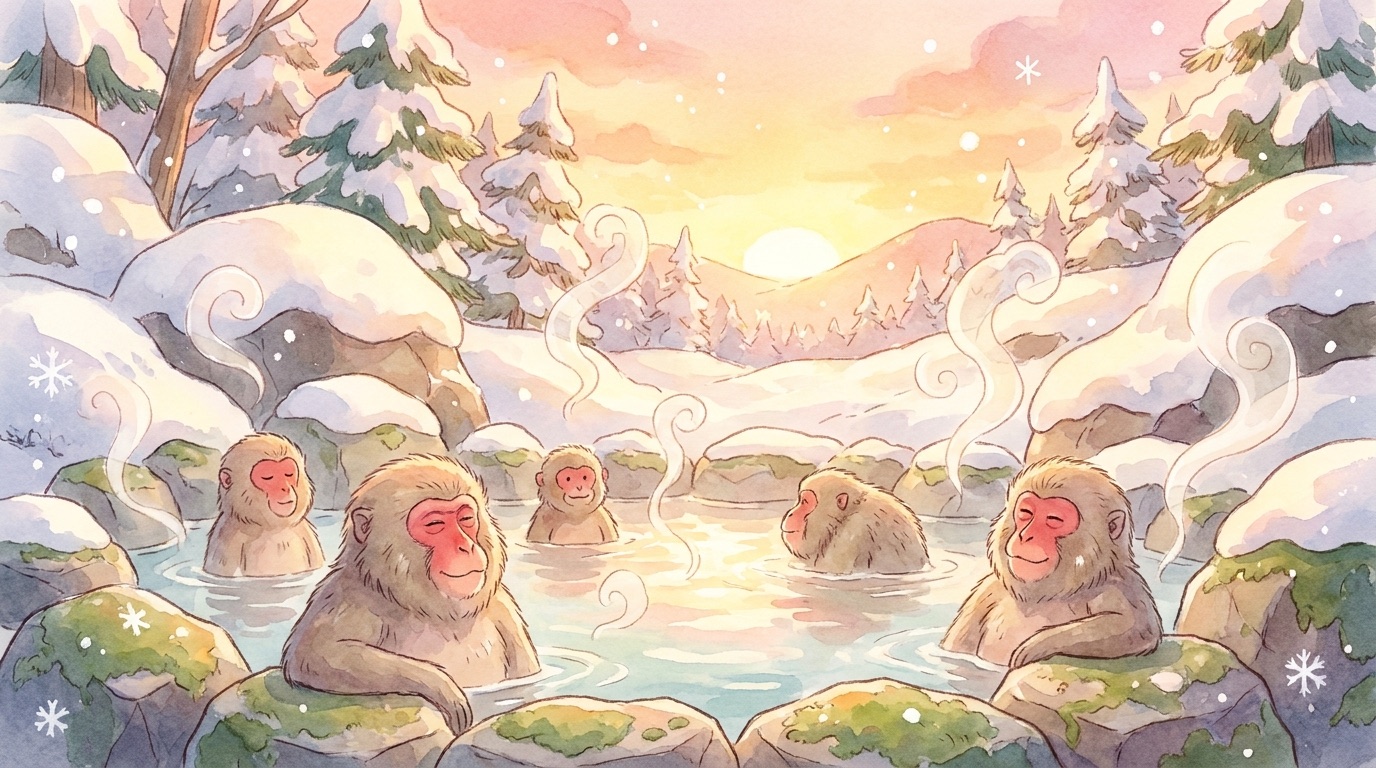
Jigokudani’s hot-spring monkeys are about an hour’s drive; Nagano’s 1,400-year-old Zenkōji temple pairs with them for the classic day away — coldest days are the best monkey days.